Luxury Home Facades: Architectural Luxury and the First Impression
Introduction: When the Facade Becomes the Language of the Home
A luxury home does not begin to make an impression when a visitor enters the living room. The first impression begins much earlier—at the moment the building is seen from the street.
The facade is the architectural element that communicates the identity of the house before anyone experiences its interior. Its proportions, materials, openings, lighting, entrance sequence, privacy strategy, and relationship with the surrounding landscape all contribute to the way the property is perceived.
For this reason, designing a luxury home facade is not simply a matter of choosing expensive stone, large glass panels, decorative columns, or an impressive entrance.
A successful facade is the result of several architectural decisions working together.
At El Helw Architects Designs, our approach to residential facades is based on understanding the building as an integrated architectural composition rather than treating the facade as an isolated decorative layer. The site, building mass, orientation, privacy requirements, architectural style, materials, lighting, and execution details all need to work together.
This approach becomes particularly important in villas, palaces, and high-end residential projects, where the facade is expected to express value while also performing practical architectural functions.
When the Facade Becomes the Language of the Home
When we look at a luxury home for the first time, we do not yet know its interior layout or the quality of its finishes. What we see first is the facade.
That is why, at El Helw Architects Designs, we consider luxury home facades to be far more than an external skin or a surface filled with stone, glass, and lighting simply to communicate a high construction cost. A facade is an architectural translation of the home's identity, the character of its site, and the lifestyle of its residents.
With more than 18 years of experience in the design and execution of villas and palaces, we have learned that a successful facade does not begin with the question:
“What luxurious shape do we want?”
Instead, it begins with deeper questions:
-
How will people approach and enter the house?
-
Where should the main entrance be located?
-
How does the sun move across the facades?
-
What are the prevailing wind conditions?
-
What level of privacy is required?
-
Which views deserve to become part of the architectural composition?
-
Which materials can maintain their appearance and performance in the local climate?
-
And how can the proposed details be executed to the required quality?
We do not design the facade separately from the building. Instead, the facade is developed alongside the interior layout, structural system, landscape design, and other building systems.
A window that looks beautiful in a 3D visualization may prove to be an unsuitable decision if it introduces excessive heat. A stone cladding system that looks luxurious may become a technical burden if its fixing method, water drainage, joints, and movement requirements have not been properly studied. Likewise, lighting that makes a facade impressive at night can become a source of glare and discomfort if its angles and intensity are not carefully designed.
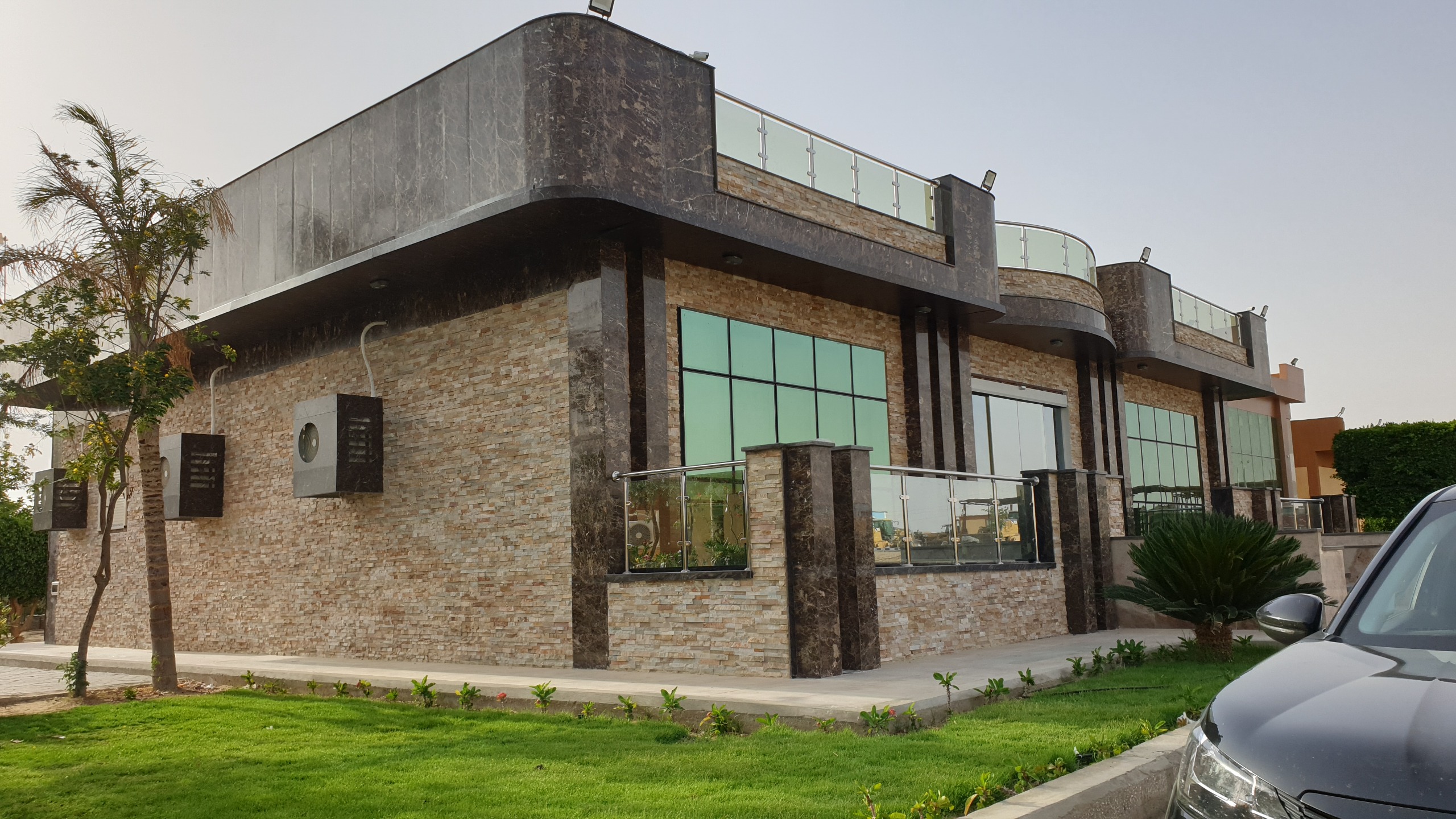
Luxury home facade combining stone, glass, and architectural lighting in a balanced composition.
Therefore, luxury home facade design, in our approach, is an integrated architectural and engineering process aimed at creating a facade that is beautiful, proportionate, comfortable, buildable, and appropriate for the environment in which the home is located.
Our Experience in Designing and Executing Villa and Palace Facades
Throughout more than 18 years of work in architectural design, execution, and supervision, we have observed at El Helw Architects Designs that the success of a luxury home facade does not begin with choosing a particular type of stone or paint color. It begins with the decisions that come before the finishing stage itself.
A facade that looks impressive in a reference image may not be the right solution for another project because every home has its own site, orientation, privacy requirements, internal spaces, proportions, and patterns of use.
For this reason, we approach facade design as part of the complete architectural system rather than as a decorative layer added to the building after the design has already been completed.
What Have We Learned from Actual Execution?
One of the most important lessons confirmed by our projects is that architectural luxury does not mean having more elements.
A facade with a limited number of carefully selected materials and details can be far more powerful and elegant than one containing multiple types of stone, glass, and decorative elements but lacking a clear visual system.
Design quality alone also does not guarantee a successful final result.
Execution details, cladding installation methods, joint treatment, color coordination, material transitions, and lighting quality all become visible during the final stage and can either elevate the facade or diminish its architectural value.
For this reason, we study the facade on several interconnected levels:
-
Architectural massing: Is the building balanced before any materials are added?
-
Proportions: Are the relationships between height, width, openings, and projecting elements logical?
-
Site: How does the facade respond to the street, views, and solar orientation?
-
Privacy: Do windows, balconies, and openings provide the required level of privacy?
-
Materials: Does the material support the design, or has it become the dominant element?
-
Execution: Can the proposed details actually be executed to the required standard?
-
Lighting: How will the facade appear at night without excessive illumination?
-
Landscape integration: Does the facade feel like part of the site, or like an isolated object?
The El Helw Perspective
In our projects, we do not begin by choosing stone or glass. We begin by understanding the architectural massing, the site, solar orientation, and privacy requirements—because the material should serve the design, not the other way around.
This distinction is particularly important in luxury homes because the success of a facade cannot be measured by the price of its materials alone. It depends on how successfully all of its elements work together.
When evaluating a residential facade, we therefore consider a series of interconnected decisions, including:
-
The proportions of the primary and secondary masses.
-
The distribution of windows, doors, and openings.
-
The relationship between interior spaces and the exterior facade.
-
The required level of privacy.
-
Solar orientation and its effect on windows and glazing.
-
Material selection according to architectural character and site conditions.
-
The visual transition from the entrance gate to the main entrance.
-
Nighttime lighting and the way architectural elements are highlighted.
-
The relationship between the facade, landscape, boundary walls, and entrances.
-
The long-term maintainability of materials and details.
-
Execution accuracy and how closely the completed work matches the approved design.
Experience Does Not Mean Repeating the Same Facade
A common mistake is to treat luxury facades as a collection of ready-made designs that can simply be repeated from one house to another.
A facade that works beautifully for one villa may be completely unsuitable for another because of differences in site conditions, orientation, internal spaces, building proportions, and family requirements.
Every project should therefore have its own architectural personality, even when it belongs to the same architectural school or design style.
What Is a Luxury Home Facade?
A luxury home facade is an architectural design that combines aesthetic identity with functional performance through the careful study of building masses, proportions, materials, openings, privacy, lighting, shading, and site conditions—not simply through the use of expensive materials.
A genuinely successful luxury facade usually depends on several key elements:
-
Balanced architectural proportions.
-
A clear and recognizable architectural identity.
-
Carefully selected materials.
-
Well-studied windows and openings.
-
Appropriate privacy levels.
-
Solar control and shading where required.
-
Architectural exterior lighting.
-
Integration with landscape design.
-
High-quality execution and detailing.
The most expensive material cannot compensate for poor proportions, inappropriate openings, weak lighting, or an architectural composition that does not respond to the site.
What We Have Learned from Real Projects
Architectural design becomes more meaningful when it is connected to actual project experience.
One of the important lessons we have gained through working on residential and palace projects is that the facade should not be designed independently from the building itself.
The El Helw approach
In our projects, we do not begin by choosing stone or glass. We begin by understanding the architectural massing, the site, solar orientation, and privacy requirements—because the material should serve the design, not the other way around.
This principle may sound simple, but it has a significant impact on the final result.
A facade can use high-end materials and still appear visually weak if:
-
The building proportions are not balanced.
-
Windows are placed without considering the overall composition.
-
The entrance is disconnected from the main architectural mass.
-
Materials are used excessively.
-
Lighting is added as an afterthought.
-
Privacy is ignored.
-
The facade does not respond to the site's climate or orientation.
Luxury therefore comes from architectural control and coherence, not from material cost alone.
How Do You Choose the Right Facade for Your Home?
The right facade is not necessarily the most decorative facade. It is the solution that responds most effectively to the priorities of the property, the owner, the site, and the architectural program.
Before selecting a style or material, it is useful to identify the project's primary priorities.
| If your priority is | A suitable architectural approach |
|---|---|
| Quiet luxury | Limited materials + accurate proportions + restrained detailing |
| Privacy | More solid masses + carefully controlled openings + screens or shading where needed |
| Views | Larger openings and glazing where appropriate + suitable solar protection |
| Contemporary character | Simple masses + clear lines + minimal ornamentation |
| Formal architectural character | Neoclassical or classical language according to the building proportions |
| Easy maintenance | Fewer sensitive details + materials suitable for the local environment |
| Hot climate | Shading + orientation analysis + appropriate glazing selection |
| Coastal location | Materials and detailing suitable for local environmental conditions |
| Redesigning an existing house | Study the existing facade first, then determine what can be retained or transformed |
| Controlled budget | Prioritize massing, proportions, entrances, and major architectural elements before adding more materials and details |
This decision-making approach is more reliable than starting with a Pinterest image or a material sample and trying to make the entire building follow it.
Modern, Neoclassical, or Classical: Which Style Is Right?
The architectural style should be selected according to the building's proportions, scale, location, owner's preferences, and functional requirements.
Modern Luxury Facades
Modern facades generally rely on:
-
Simple geometric masses.
-
Clear horizontal and vertical lines.
-
Controlled material combinations.
-
Large openings where appropriate.
-
Strong relationships between solid and transparent surfaces.
-
Minimal decorative elements.
-
Integrated lighting.
Modern does not necessarily mean completely flat, empty, or dominated by glass.
A successful modern facade depends heavily on proportion, shadow, depth, material transitions, and the relationship between different architectural masses.
Neoclassical Facades
Neoclassical architecture can provide a formal and refined identity while maintaining a degree of visual simplicity compared with highly ornamental classical architecture.
Common elements may include:
-
Symmetrical or balanced compositions.
-
Columns or pilasters.
-
Defined entrances.
-
Controlled cornices and moldings.
-
Stone or stone-like finishes.
-
Formal window arrangements.
However, neoclassical architecture requires discipline.
Adding classical elements randomly to a modern building does not automatically create a successful neoclassical facade.
Classical Facades
Classical architecture generally depends more strongly on:
-
Symmetry.
-
Architectural hierarchy.
-
Columns.
-
Entablatures and cornices.
-
Decorative details.
-
Formal entrances.
-
Strong visual axes.
In villas and palaces, the scale of these elements must be carefully coordinated with the overall building.
An oversized column or excessive ornamentation can make the facade feel visually heavy rather than luxurious.
What Makes a Home Facade Truly Luxurious?
Luxury is not a single material, color, or architectural style.
It is the result of several layers of decisions being coordinated.
1. Proportion
Proportion is one of the most important foundations of architectural quality.
A facade can be built with expensive materials and still fail if the windows, doors, columns, masses, and horizontal divisions do not relate properly to one another.
Good proportions create visual calm.
2. Architectural Identity
A luxury house should have a recognizable architectural language.
The facade should answer questions such as:
-
Is the building modern?
-
Is it neoclassical?
-
Is it classical?
-
Is it minimalist?
-
Is it inspired by a specific regional character?
Mixing unrelated styles without a clear design strategy often creates visual confusion.
3. Material Discipline
Using more materials does not necessarily create more luxury.
In many successful facades, a limited palette is used very carefully.
For example:
-
Natural stone as a dominant material.
-
Glass as a transparent counterpoint.
-
Metal or ACM as a controlled accent.
-
Wood as a warm secondary element.
-
Exterior paint as a supporting surface.
The objective is not to display every available material. It is to create hierarchy.
4. The Entrance Sequence
The entrance is one of the most important elements of the first impression.
A successful entrance should be considered together with:
-
The main gate.
-
The pedestrian approach.
-
The entrance canopy.
-
The main door.
-
Exterior lighting.
-
Landscape.
-
Vertical proportions.
-
The transition between exterior and interior.
The entrance should feel like the natural conclusion of the facade rather than an element attached to it.
What Are the Most Important Questions Before Designing a Luxury Facade?
What Is the Best Facade for a Villa?
There is no single best facade for every villa. The best facade is the one that balances architectural identity, proportions, climate, orientation, privacy, views, materials, maintenance, and budget. A modern facade may be appropriate for one site, while a neoclassical or classical approach may be more suitable for another.
What Is the Difference Between Modern and Neoclassical Facades?
Modern facades generally emphasize simple masses, clean lines, controlled materials, and minimal ornamentation, while neoclassical facades rely more on symmetry, architectural hierarchy, classical proportions, and selected decorative elements. The correct choice depends on the building rather than fashion alone.
Is Natural Stone Better Than Artificial Alternatives?
Natural stone is not automatically the best choice for every project. Its suitability depends on the architectural concept, location, environmental conditions, maintenance requirements, budget, and execution quality. A well-selected alternative material can sometimes be more appropriate than natural stone if it meets the project's technical and aesthetic requirements.
Is Large Glass Suitable for Hot Climates?
Large areas of glazing can be used successfully in hot climates, but their performance depends on orientation, glass specifications, shading, window design, and the overall environmental strategy. Large glass surfaces should therefore be considered as part of the architectural and environmental design rather than as a purely aesthetic decision.
How Can Homeowners Maintain Privacy?
Privacy can be achieved through a combination of building massing, window placement, setbacks, screens, landscaping, shading devices, and controlled views. The best solution does not necessarily mean eliminating windows; instead, it means controlling what can be seen from outside and what residents can see from inside.
What Are the Most Common Facade Design Mistakes?
The most common mistakes include:
-
Choosing a style before studying the building.
-
Excessive use of decorative materials.
-
Poor window proportions.
-
Ignoring solar orientation.
-
Treating lighting as an afterthought.
-
Ignoring privacy.
-
Using unsuitable materials for the environment.
-
Mixing too many architectural styles.
-
Designing the facade without considering landscape.
-
Failing to coordinate design and execution details.
Can the Facade of an Existing House Be Changed?
Yes, an existing facade can often be redesigned, but the possibilities depend on the existing structure, openings, building regulations, services, site conditions, and the extent of the desired transformation. A professional assessment should determine which elements can be retained, modified, concealed, or completely redesigned.
How Should Exterior Lighting Be Selected?
Exterior lighting should reinforce the architecture rather than simply illuminate the building. The lighting strategy should consider entrances, architectural masses, textures, landscape, circulation, shadows, and nighttime visibility while avoiding excessive glare or visual clutter.
What Is the Best Color for a Luxury Home Facade?
There is no universally best color for a luxury facade. The right palette depends on architectural style, materials, climate, surroundings, landscape, and the desired visual character. Neutral and natural palettes often provide long-term flexibility, but stronger colors can also work when they are integrated into a coherent architectural concept.
Does Facade Design Affect Construction Cost?
Yes. Facade design can have a significant effect on construction cost because materials, openings, detailing, structural requirements, shading systems, cladding methods, lighting, and execution complexity all influence the final scope. Good design does not necessarily mean higher cost; it means directing the budget toward the elements that contribute most to the architectural result.
Choosing Luxury Facade Materials
Material selection should follow the architectural concept rather than define it.
Natural Stone
Natural stone can provide depth, permanence, texture, and a strong sense of architectural quality.
It can be particularly effective in:
-
Luxury villas.
-
Palaces.
-
Formal entrances.
-
Feature walls.
-
Architectural frames.
-
Ground-floor elements.
However, stone selection should consider:
-
Type of stone.
-
Surface finish.
-
Thickness and fixing method.
-
Environmental exposure.
-
Cleaning and maintenance.
-
Compatibility with other facade materials.
The goal is not to cover the entire building with stone simply because stone is perceived as luxurious.
Glass
Glass provides transparency and can strengthen the relationship between indoor and outdoor spaces.
It can be particularly valuable when:
-
Views are important.
-
Natural daylight is a priority.
-
The architecture benefits from visual openness.
-
The site allows sufficient privacy.
However, large glazing areas should be carefully evaluated for:
-
Solar exposure.
-
Shading.
-
Thermal performance.
-
Privacy.
-
Glare.
-
Interior comfort.
ACM and Metal Elements
Aluminum composite materials and other metal finishes can contribute to a contemporary architectural language.
They can be used to create:
-
Horizontal bands.
-
Canopies.
-
Frames.
-
Feature walls.
-
Visual accents.
The success of these materials depends heavily on detailing and how they meet stone, glass, paint, and other surfaces.
Treated Wood
Wood can introduce warmth and contrast into a facade.
It can be used for:
-
Entrance doors.
-
Screens.
-
Feature ceilings.
-
Decorative wall sections.
-
Outdoor architectural elements.
Exterior wood, however, must be selected and treated according to its intended environment and maintenance requirements.
Exterior Paint
Paint remains an important facade material, especially when used as a supporting surface rather than the sole architectural feature.
It can help:
-
Balance stronger materials.
-
Create visual continuity.
-
Reduce unnecessary material complexity.
-
Control the overall color palette.
Material Comparison
| Material | Main Strength | Important Consideration |
|---|---|---|
| Natural stone | Texture, permanence, visual richness | Selection, fixing, maintenance, cost |
| Glass | Transparency and daylight | Solar control, privacy, thermal performance |
| ACM/metal | Contemporary appearance and clean detailing | Joints, installation quality, material compatibility |
| Treated wood | Warmth and contrast | Environmental exposure and maintenance |
| Exterior paint | Flexibility and cost control | Surface preparation and durability |
The best facade is not necessarily the one containing the largest number of materials.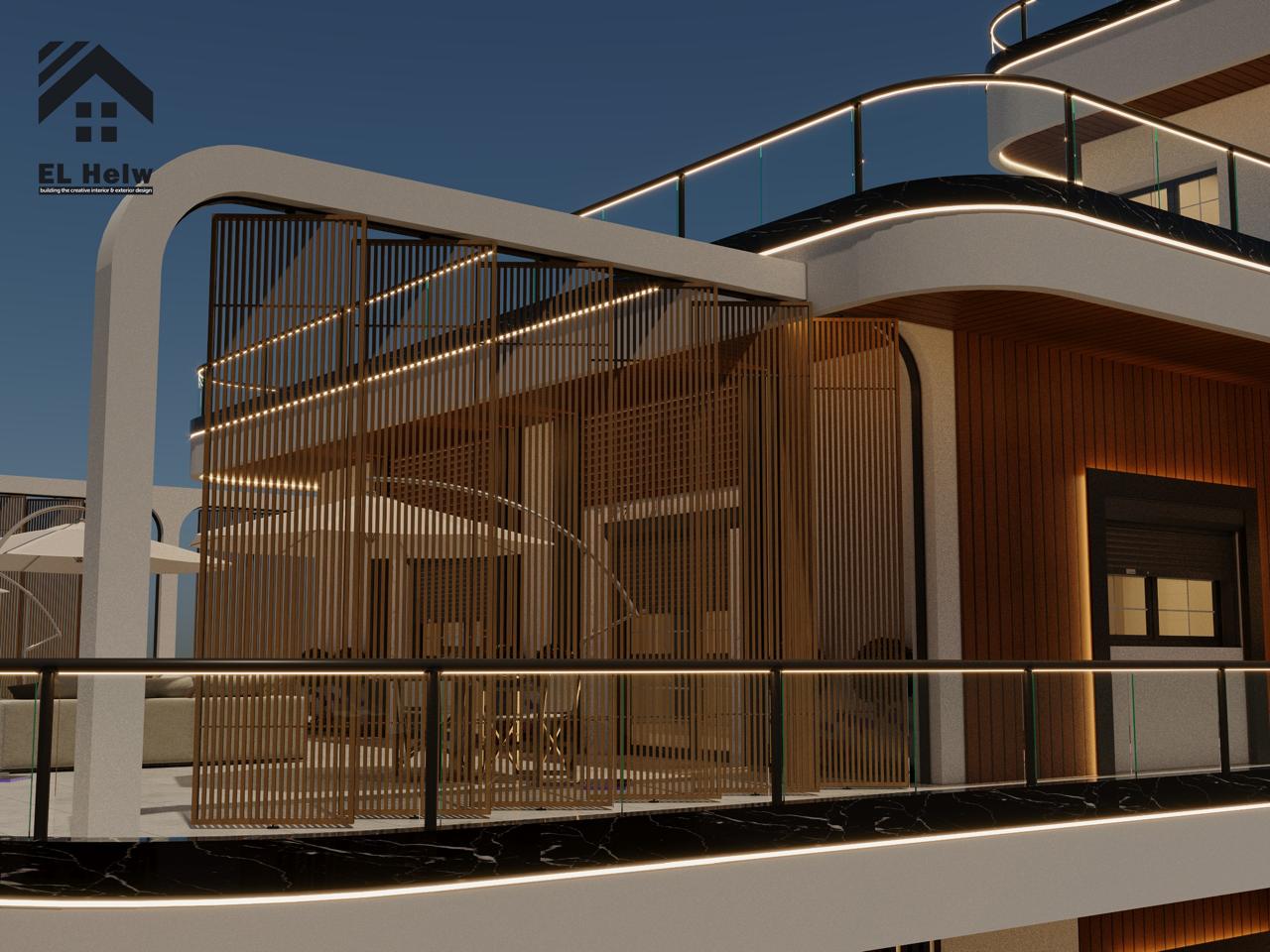
In many cases, three well-coordinated materials can create a stronger result than six unrelated materials.
Windows, Openings, and Solar Shading
Windows are not simply holes in the wall.
They are part of the architectural composition and influence:
-
The facade rhythm.
-
Interior daylight.
-
Views.
-
Privacy.
-
Thermal comfort.
-
Exterior appearance.
-
Energy performance.
The location and size of openings should therefore be studied during the architectural design stage.
Large glazing can create a dramatic luxury effect, but it should not be used indiscriminately.
The orientation of the facade matters.
A window facing strong direct sunlight may require a different strategy from one receiving more controlled daylight.
Possible solutions include:
-
Horizontal overhangs.
-
Vertical fins.
-
Screens.
-
Recessed windows.
-
Architectural louvers.
-
Appropriate glazing specifications.
-
Landscape shading.
Solar control should be integrated into the architecture rather than added as an unattractive technical solution later.
Privacy as an Architectural Design Decision
Privacy is particularly important in villas and palaces.
The challenge is to create openness without sacrificing the residents' sense of security and privacy.
This can be achieved through:
-
Controlled window placement.
-
Solid and transparent massing.
-
Boundary walls.
-
Screens.
-
Landscape buffers.
-
Strategic setbacks.
-
Entrance orientation.
-
Shading elements.
Privacy should ideally be considered from the beginning of the design process.
Trying to solve privacy problems after the facade is completed can result in visually disconnected additions such as improvised curtains, external screens, or oversized boundary elements.
Architectural Lighting: The Facade After Sunset
A facade has two identities:
its daytime identity and its nighttime identity.
Architectural lighting should reveal the building's important features rather than simply make everything bright.
Lighting can emphasize:
-
Entrance elements.
-
Stone textures.
-
Architectural columns.
-
Vertical masses.
-
Canopies.
-
Landscaping.
-
Paths and circulation.
-
Selected facade details.
A successful lighting strategy creates hierarchy.
Not every part of the building needs the same intensity.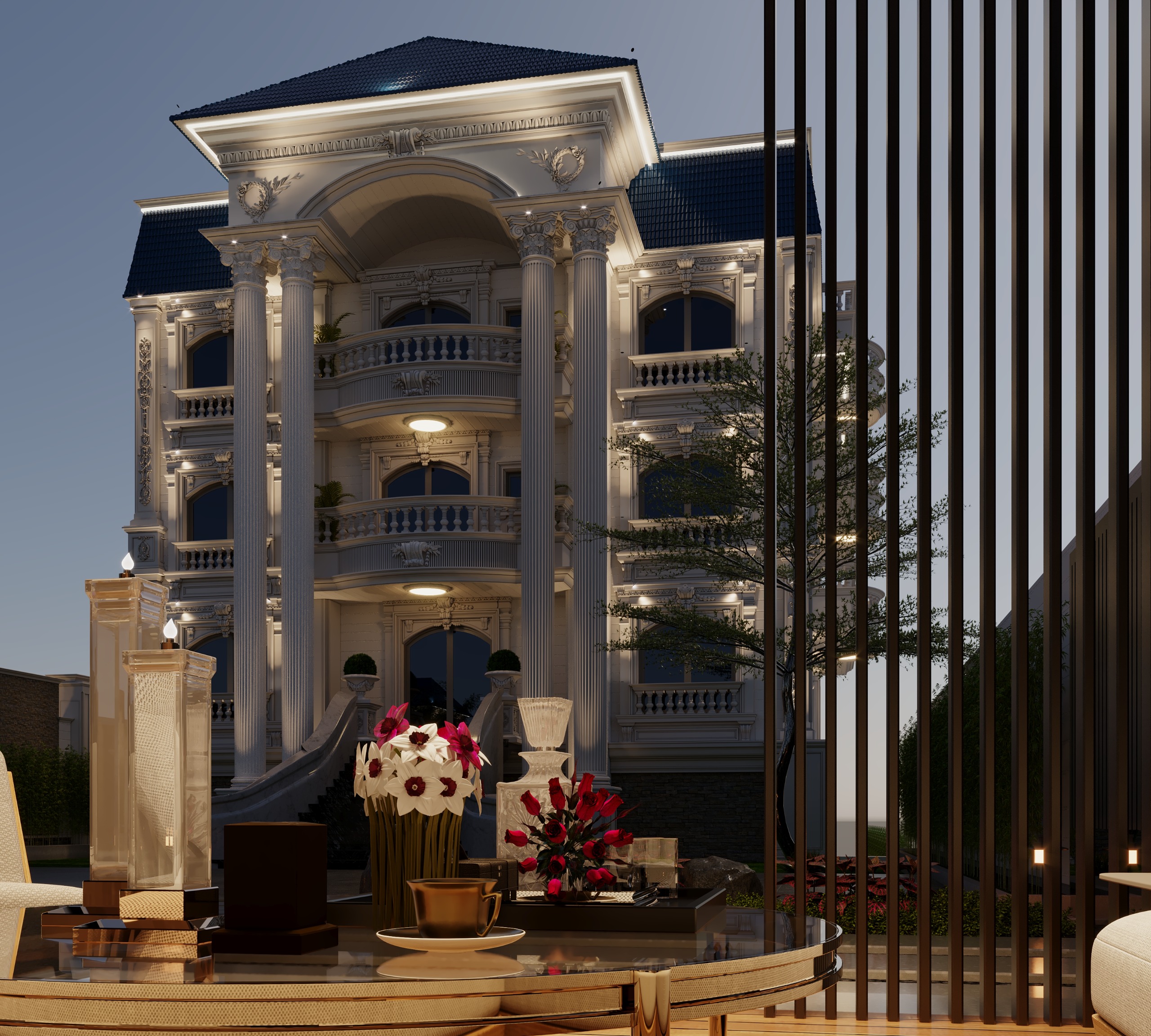
Excessive lighting can eliminate shadows and make a sophisticated facade appear flat.
Integrating the Facade with Landscape
The building should not stop at the edge of the wall.
Landscape design can strengthen the architectural composition by creating a transition between the building and its surroundings.
Landscape elements may include:
-
Trees.
-
Shrubs.
-
Ground covers.
-
Decorative planting.
-
Water features.
-
Pathways.
-
Outdoor seating areas.
-
Architectural planters.
The relationship between architecture and landscape becomes particularly important at entrances.
A strong entrance sequence may combine:
gate → landscape → pathway → entrance → door → interior transition.
This sequence creates an experience rather than simply presenting a facade.
Common Mistakes in Luxury Facade Design
1. Starting with Materials Instead of Architecture
Selecting marble, stone, or decorative panels before defining the architectural massing often leads to a facade that looks expensive but lacks coherence.
2. Using Too Many Materials
Multiple materials can create visual noise.
Luxury generally benefits from hierarchy and restraint.
3. Copying Another Villa
A facade that works beautifully on one property may fail completely on another because of differences in:
-
Plot dimensions.
-
Building proportions.
-
Orientation.
-
Climate.
-
Surroundings.
-
Views.
-
Privacy requirements.
Reference images can inspire the design, but they should not replace architectural analysis.
4. Ignoring the Roofline
The roofline can have a major effect on the overall silhouette of a villa or palace.
Mechanical equipment, service elements, parapets, water tanks, and roof structures should be considered as part of the architectural composition whenever possible.
5. Poor Window Alignment
Misaligned windows can weaken an otherwise expensive facade.
The vertical and horizontal relationships between openings should be studied carefully.
6. Excessive Ornamentation
Adding more moldings, columns, frames, and decorative elements does not necessarily increase luxury.
The correct amount of detail depends on the architectural style and scale.
7. Treating Lighting as Decoration
Random spotlights and excessive illumination can damage the nighttime appearance of the building.
Lighting should follow the architectural hierarchy.
8. Ignoring Maintenance
A material may look excellent on completion day but become problematic if it requires unsuitable maintenance or performs poorly in the local environment.
The lifecycle of the facade should be considered.
How Much Does a Luxury Facade Cost?
There is no single reliable price for a luxury facade because the final cost depends on the project's specific design and execution requirements.
Major cost factors include:
Building Size
A larger facade naturally requires more materials, labor, scaffolding, detailing, and installation.
Architectural Complexity
A simple contemporary facade and a highly detailed classical facade may have very different execution requirements even when their surface areas are similar.
Materials
Natural stone, engineered materials, glass systems, metal, wood, paint, and specialty finishes all have different costs and installation requirements.
Windows and Glazing
Large openings can increase costs through:
-
Glass area.
-
Frame systems.
-
Structural requirements.
-
Solar-control specifications.
-
Installation complexity.
Lighting
The final lighting budget depends on the number and type of fixtures, electrical infrastructure, control systems, installation, and integration with the architecture.
Shading Systems
Louvers, screens, canopies, and other solar-control elements add both material and execution costs.
Site Conditions
Accessibility, building height, existing construction, surrounding buildings, and logistical constraints can affect execution.
Existing Buildings
Redesigning an existing facade can involve demolition, structural modifications, repairs, waterproofing, new openings, and adaptation of existing services.
Therefore, the most useful approach is not to ask only:
“How much does a luxury facade cost per square meter?”
Instead, the project should be assessed according to its actual architectural scope.
Beauty Only vs. Integrated Architectural Performance
| Beauty-focused approach | Integrated architectural approach |
|---|---|
| Focuses mainly on appearance | Balances appearance and performance |
| Selects materials first | Establishes architectural concept first |
| May prioritize decorative elements | Prioritizes proportion and hierarchy |
| Treats windows visually | Studies views, daylight, privacy, and solar exposure |
| Adds lighting at the end | Integrates lighting into the design |
| May ignore maintenance | Considers lifecycle and environmental conditions |
| Focuses on completion-day appearance | Considers long-term performance |
A luxury facade should ultimately belong to the second category.
Real Project Experience: What Can We Learn?
Al Ghoul Palace
One of the important challenges in the Al Ghoul Palace project was that the existing building did not adequately reflect the value expected from the project.
The site itself was also a significant consideration.
The redesign therefore focused on rebuilding the architectural identity and improving the relationship between the building mass and the surrounding land.
The lesson is important:
Facade redesign is not always about replacing finishes. Sometimes the real issue is the architectural identity of the building itself.
saba Palace
At Rouq Palace, the existing building did not sufficiently express the character expected from a palace.
The work therefore addressed the external architectural identity, including the relationship between the facade, roofline, and lighting.
This demonstrates how several seemingly separate elements can influence one another.
A facade cannot always be improved by changing its wall finish alone.
Sheikh Ali Hamdy Palace
The Sheikh Ali Hamdy Palace project involved three integrated seafront villas.
One of the main architectural challenges was to achieve a balance between:
-
Sea views.
-
Privacy.
-
A unified architectural composition.
-
The identity of the individual villas.
-
Coastal environmental conditions.
The project demonstrates the importance of responding to the site rather than forcing a predetermined facade style onto it.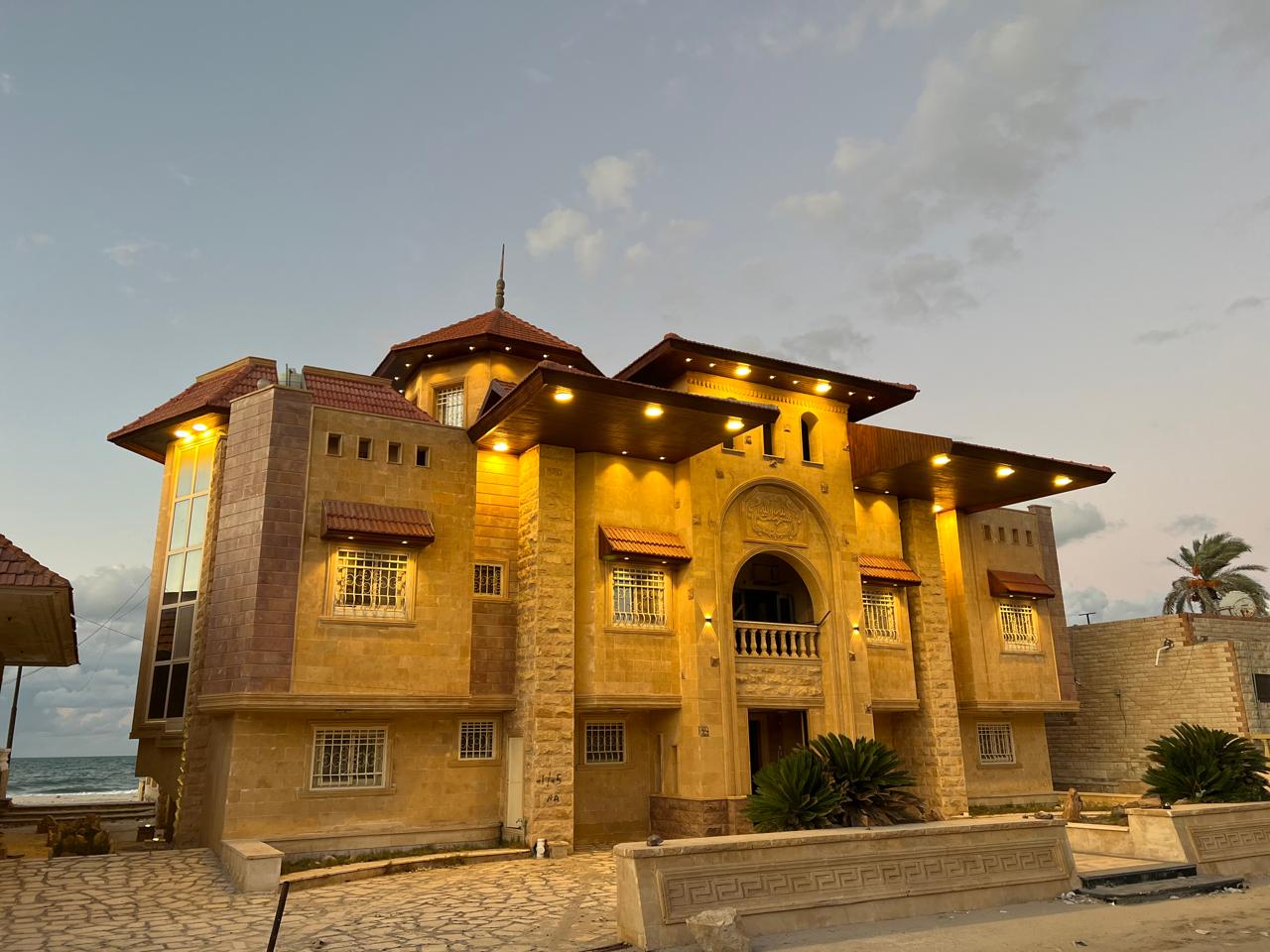
In a coastal environment, humidity, salt exposure, and local environmental conditions should also influence material and detailing decisions.
Does the Facade Affect Property Value?
The facade can contribute to the perceived value of a property because it influences the first impression, architectural identity, perceived quality, and relationship between the building and its surroundings.
However, facade appearance alone does not determine property value.
Other factors include:
-
Location.
-
Plot size.
-
Building quality.
-
Interior design.
-
Layout.
-
Construction quality.
-
Services.
-
Landscape.
-
Maintenance.
-
Overall property functionality.
A visually impressive facade can strengthen the property's presentation, but it should be part of a broader quality strategy.
Can a Luxury Facade Be Designed on a Controlled Budget?
Yes.
Luxury does not necessarily require unlimited spending.
A controlled budget can still produce a strong architectural result if the budget is directed toward the elements with the greatest visual and functional impact.
For example, priority may be given to:
-
Architectural massing.
-
Entrance design.
-
Proportions.
-
Main facade material.
-
Window composition.
-
Lighting.
-
Landscape relationship.
Instead of applying expensive materials everywhere, the design can use them strategically at focal points.
This is one of the most effective ways to achieve a refined appearance without unnecessary material complexity.
How Does El Helw Architects Designs Approach Facade Projects?
Our process begins with understanding the project rather than immediately selecting finishes.
1. Understanding the Site
We study:
-
Plot conditions.
-
Surrounding buildings.
-
Orientation.
-
Views.
-
Access.
-
Privacy.
-
Environmental conditions.
2. Defining the Architectural Identity
The architectural language is established according to:
-
Building type.
-
Owner preferences.
-
Site.
-
Scale.
-
Existing architectural context.
3. Developing the Massing
Before detailed materials are selected, the main architectural volumes and proportions are developed.
This stage is essential because materials cannot correct fundamentally weak massing.
4. Studying Openings
Windows and doors are coordinated with:
-
Interior functions.
-
Views.
-
Privacy.
-
Natural light.
-
Solar exposure.
-
Exterior composition.
5. Selecting Materials
Materials are then selected according to their:
-
Appearance.
-
Performance.
-
Location.
-
Maintenance.
-
Compatibility with other materials.
-
Project budget.
6. Integrating Lighting and Landscape
Lighting and landscape are considered as part of the overall architectural experience.
7. Preparing for Execution
The design must ultimately be translated into drawings and details that can be executed accurately.
A beautiful concept that cannot be translated into precise construction details is not enough.
What Should the Client Receive Before Execution?
Before construction begins, the client should have a clear understanding of what is being built.
Depending on the project's scope, this may include:
-
Architectural facade drawings.
-
Elevations.
-
Material specifications.
-
Color selections.
-
Window and door details.
-
Entrance details.
-
Lighting locations.
-
Landscape coordination.
-
Material samples.
-
Relevant construction details.
-
Execution specifications.
-
Coordination drawings where required.
The exact documentation depends on the project's size and scope, but the principle remains the same:
The closer the design is to execution-ready documentation, the lower the risk of unexpected visual and technical changes during construction.
How Was This Guide Prepared?
This guide is based on architectural and finishing experience gained through residential and palace-related projects, combined with practical observations from design, material selection, facade development, and execution.
The objective is not to present one universal facade style.
Instead, the guide focuses on the decisions that repeatedly influence the quality of luxury residential facades:
-
Architectural proportions.
-
Building identity.
-
Material selection.
-
Openings.
-
Privacy.
-
Solar control.
-
Lighting.
-
Landscape.
-
Execution.
-
Long-term performance.
Where technical decisions depend on the project, they should be evaluated according to the actual site and design conditions rather than treated as universal rules.
Useful Related Guides
For readers who want to explore specific aspects of facade design in greater depth, the following resources can be used as complementary references:
-
Luxury Villa and Mansion Facades: The Definitive Architectural Guide to Styles, Materials, and Engineering Excellence
-
A Comprehensive Guide to Luxury Architectural Facade Engineering, Design, and Foundations
-
Sheikh Ali Hamdy Palace: Three Integrated Seafront Villas and Their Unique Architectural Design
-
Designing Villas and Palaces in El Arish: Coastal Climate and Privacy
-
Luxury Finishing Materials: What Is Truly Worth Investing In?
-
Designing Foyers and Living Halls in Apartments, Villas, and Palaces
These topics complement the present article rather than replacing it. This article focuses primarily on the first impression, architectural decision-making, luxury perception, and practical facade selection, while the more technical guides address specific engineering and design considerations in greater depth.
Frequently Asked Questions
What is the most important element of a luxury facade?
Proportion is one of the most important elements. Even expensive materials can appear ordinary when the architectural proportions are weak.
Should the entire facade use natural stone?
Not necessarily. Stone can be used selectively as part of a coordinated material palette.
Are large windows always better?
No. Larger windows may improve views and daylight but can also introduce privacy, glare, solar exposure, and thermal-performance considerations.
Is modern architecture more luxurious than classical architecture?
Neither style is inherently more luxurious. Luxury depends on the quality of design, proportion, materials, detailing, and execution.
Can an old villa be transformed into a luxury-looking property?
In many cases, yes. The extent of transformation depends on the existing structure, facade, openings, services, regulations, and project objectives.
How many facade materials should be used?
There is no fixed number. The goal should be visual hierarchy and compatibility rather than maximizing material variety.
What is more important: facade design or execution?
Both are essential. A strong design can lose much of its value through poor execution, while excellent execution cannot fully compensate for a fundamentally weak design.
When should facade lighting be designed?
Ideally during the architectural design process, so that electrical requirements, fixture positions, shadows, landscape, and architectural details can be coordinated before execution.
Should landscape be designed separately from the facade?
For a high-end villa or palace, it is generally better to coordinate landscape and facade design because the two elements strongly influence the entrance experience and overall visual composition.
Author
Written by: Sami El Helw
Professional Title: Finishing Engineer
Experience: More than 18 years
Field: Finishing works and architecture-related residential projects
The article reflects practical experience in architectural finishing, facade development, material selection, and project execution.
Conclusion: Luxury Begins Before the Door
A luxury home facade is not simply the outer skin of a building.
It is the first architectural statement the property makes.
It communicates identity, establishes expectations, controls views and privacy, interacts with light, frames the landscape, and influences how the entire property is perceived.
The strongest facades are not necessarily the most expensive or the most decorated.
They are the ones where:
massing, proportions, materials, openings, privacy, shading, lighting, landscape, and execution work together as one architectural idea.
That is why facade design should begin with architecture—not with a material catalogue.
At El Helw Architects Designs, we approach villa and palace facades by studying the building, the site, the owner's requirements, and the intended architectural identity before developing materials and finishing details.
If you are planning a new villa or palace, or considering redesigning the facade of an existing home, the right starting point is a professional architectural assessment of the building and its site.
A successful facade does not simply make the house look luxurious. It makes the architecture feel intentional, balanced, and valuable.
Ready to Develop Your Home's Facade?
If you are planning a luxury villa, palace, or residential facade redesign, contact El Helw Architects Designs to discuss your project requirements and develop an architectural solution suited to your site, style, and priorities.
Planning a Luxury Facade for Your Villa or Palace?
Start with the right architectural design before choosing the materials. At El Helw Architects Designs, we develop integrated facades that combine architectural identity, balanced proportions, suitable materials, privacy, lighting, and execution details tailored to your project and site.
Contact us to discuss your project and start developing its architectural facade.