Smart Maintenance Schedule for Luxury Villas After Handover: An Engineering Guide to Preserving Performance and Value
A smart maintenance schedule for a luxury villa after handover transforms maintenance from reactive repair into a preventive operating system covering HVAC, electrical systems, plumbing, waterproofing, façades, swimming pools, landscaping, and irrigation. The goal is not simply to fix failures, but to detect early warning signs, document maintenance history, identify root causes, and determine when a technician or engineer should intervene.
Why Should Villa Maintenance Start on Handover Day Rather Than When a Failure Appears?
We consider villa handover the beginning of a new operational phase, not the end of the project.
A luxury home combines architectural, structural, electrical, mechanical, water, and finishing systems that work together every day. Therefore, preventive maintenance should begin from the moment the property is handed over by documenting the systems, materials, equipment, and service access points, and then building a maintenance schedule that reflects the specific villa.
The problem in many villas is not that the owner completely neglects the property. Instead, maintenance often happens reactively:
A leak appears, so a plumber is called.
An air-conditioning unit stops working, so a technician is called.
Paint starts peeling, so the wall is repainted.
This approach may address the visible symptom, but it does not always identify the underlying cause.
Smart maintenance looks at the villa as an integrated system.
The core idea is simple:
We do not ask only, “What failed?” We also ask, “Why did it fail, and was there an early warning sign that could have been detected before it became an expensive repair?”
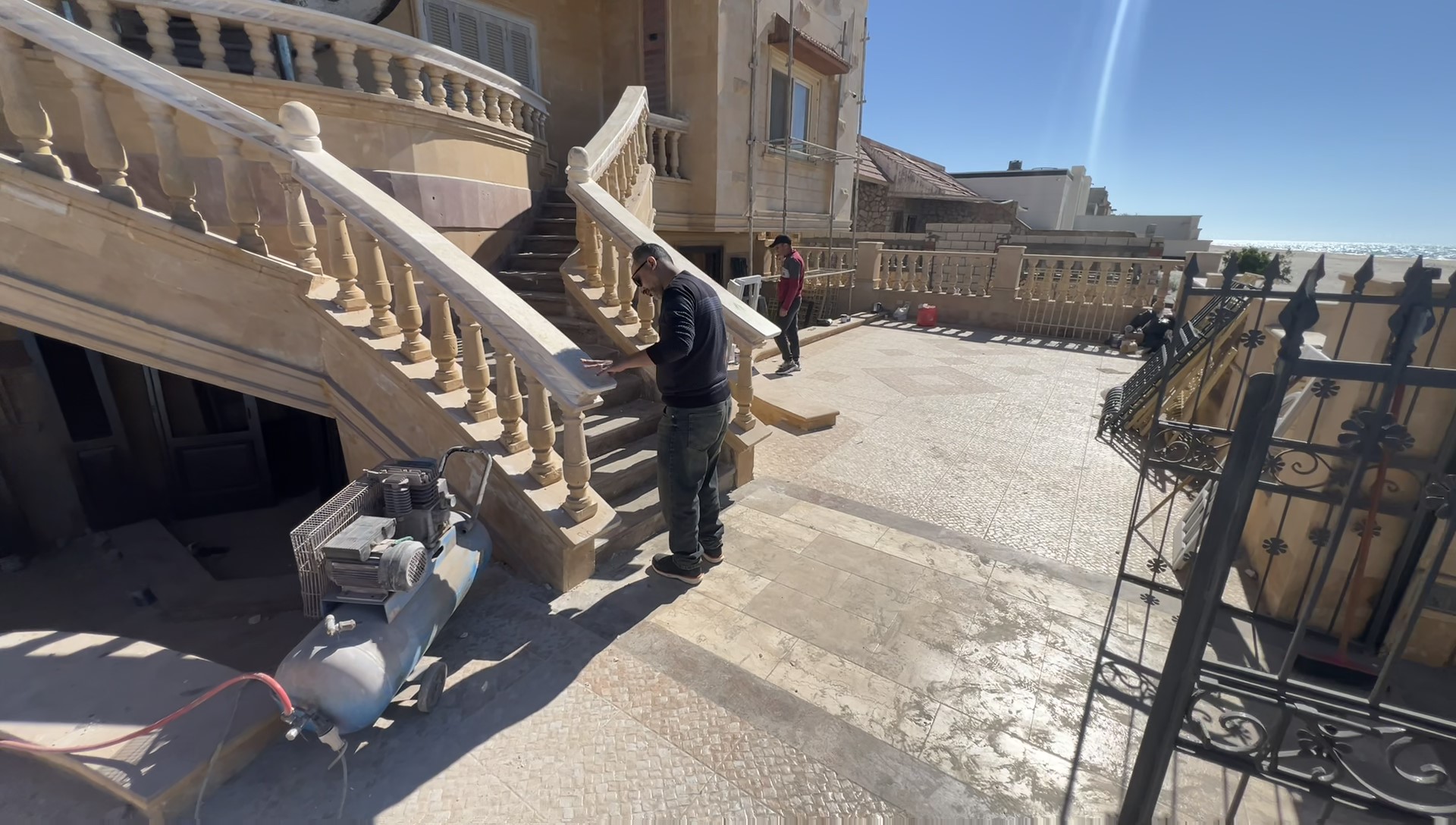
Preventive maintenance diagram showing villa systems from roof and façade to HVAC and swimming pool
What Is a Smart Maintenance Schedule for a Luxury Villa?
We define a smart maintenance schedule as a periodic plan that connects every important element in the villa with four essential pieces of information:
What should be inspected? When should it be inspected? Who is responsible for the inspection? And when should the issue be escalated to technical or engineering intervention?
The objective is not to increase the number of maintenance visits. It is to identify changes before they become failures that affect the building or its users.
A good maintenance schedule cannot be identical for every villa.
The operating period, HVAC system, swimming pool, façade materials, waterproofing system, smart-control systems, landscaping, irrigation, and number of occupants can all change the maintenance priorities.
For this reason, we consider manufacturer instructions an integral part of the maintenance schedule rather than a replacement for it. The general schedule provides the framework, while the specifications of each piece of equipment or system determine certain inspection, cleaning, servicing, and replacement requirements.
Quick Answer
The best way to maintain a luxury villa after handover is to divide the building into clearly defined systems, establish periodic inspection tasks for each system, record the inspection results in a maintenance log, and escalate unclear or recurring problems to a qualified technician or engineer rather than simply repairing the visible symptoms.
This includes HVAC, Plumbing, Waterproofing, Electrical Systems, Façade, Pool, and Landscape & Irrigation.
The key is not to wait for failure. It is to identify the warning signs that precede failure, connect each observation to its possible cause, and determine the appropriate level of intervention before a small problem develops into damage to finishes, systems, or property value.
In short: smart maintenance does not ask only, “What failed?” It also asks, “What sign preceded the failure? Why did it appear? And does it require simple monitoring, technical maintenance, or engineering intervention?”
Smart maintenance does not wait for failure; we look for the sign that comes before it.
How Do We Build a Maintenance Schedule After Villa Handover?
We do not begin by writing a long list of maintenance tasks.
We first transform the villa into an Asset Register.
We record every important system, its location, function, and technical information, and then connect it to an inspection schedule.
Depending on the project, this may include:
-
Main electrical panels and circuits.
-
HVAC and ventilation units and systems.
-
Water pumps and tanks.
-
Water heaters and hot-water systems.
-
Drainage networks.
-
Water-supply and irrigation points.
-
Waterproofing layers and critical areas.
-
Roofs and terraces.
-
Façades and finishing materials.
-
Doors, windows, and glazing.
-
Exterior lighting systems.
-
Control and automation systems, where applicable.
-
Swimming pool and pool equipment.
-
Irrigation and landscaping systems.
-
Service rooms.
-
Any modifications made during construction.
This documentation is important because maintenance years after handover should not depend on the memory of a technician or owner.
We also place particular importance on maintaining As-Built Drawings whenever modifications are made during construction. Monitoring cannot be accurate if the documentation does not reflect the actual condition of the villa.
This is consistent with our approach of connecting design accuracy with construction supervision, follow-up, and documentation of changes.
What Is the Main Maintenance Schedule for a Luxury Villa?
We divide maintenance into different time intervals rather than treating it as one fixed appointment.
The following schedule is an operational framework. Final details should always be adjusted according to the system type, manufacturer requirements, project conditions, and actual usage.
| Period | Main Inspection Areas | Objective |
|---|---|---|
| Daily / Weekly | Visible leaks, abnormal pressure, lighting, drains, pool, HVAC when operating | Detect early changes |
| Monthly | Visible panels and components, filters according to the system, plumbing, drainage, visible façade elements, irrigation, service rooms | Prevent problems from accumulating |
| Quarterly | HVAC systems, water pumps, drainage, waterproofing and water-exposed areas, exterior lighting, landscaping | Review performance |
| Semi-annually | Façades, roofs, joints, doors and windows, equipment, wet areas, control systems | Conduct a deeper condition assessment |
| Annually | Comprehensive review of systems, documentation, recurring failures, and modifications | Update the maintenance plan |
This does not mean every component requires the same procedure at every interval.
Some equipment has specific manufacturer instructions, while some conditions cannot be assessed through visual inspection alone.
We always prefer the schedule to function as a flexible system rather than a rigid calendar.
How Do We Decide Whether a Problem Is Simple or Requires an Engineer?
This is one of the most important elements of a smart maintenance schedule.
Not everything requires an engineer, but not everything can be solved by a technician.
Engineering Decision Framework
A problem appears
↓
Is it related to water?
-
Yes → Determine whether the source is plumbing, drainage, waterproofing, roof, façade, or condensation.
-
If the source is unclear → A technical or engineering inspection is required before repairing the finish.
Is it electrical?
-
Yes → Do not simply reset the breaker or replace a light if the problem keeps recurring.
-
A recurring electrical failure requires identification of the cause rather than repeated restarting.
Is the problem related to HVAC?
-
Check the nature of the problem according to the system type.
-
Continuous performance reduction, unexpected water, or unusual noises should be technically inspected.
Is the problem only related to a finish?
-
First verify that there is no underlying cause.
-
Peeling paint or wall swelling may be caused by moisture rather than a paint defect.
Does the problem affect a structural element or represent a change to the building?
-
This should not be treated as ordinary household maintenance.
-
Refer it to a qualified engineer for assessment.
This is the difference between repairing a problem and diagnosing a problem.
When Is Maintenance the Owner’s Responsibility, and When Do We Need a Technician or Engineer?
We divide responsibilities into four clear levels so that a minor issue does not automatically become an engineering visit, while a major problem is not incorrectly treated as routine household maintenance.
| Condition | First Action | Intervention Level |
|---|---|---|
| Visible dirt or simple monitoring | Owner inspection | Owner Check |
| Cleaning or operational procedure according to system instructions | Technician | Technician Maintenance |
| Unknown-source leak or recurring problem | Specialist diagnosis | Engineer / Specialist |
| Problem that may affect safety or the building | Stop use when necessary and seek specialist intervention | Engineering / Emergency |
These boundaries are particularly important in villas containing multiple systems and concealed equipment.
The owner should know what can be monitored personally. The technician should know when to stop treating the symptom. The engineer should have access to the full history of the problem.
Why Is Moisture One of the Most Important Maintenance Issues in a Luxury Villa?
We do not treat moisture as merely a paint problem.
A stain, peeling finish, discoloration, swelling, or musty odor may result from a water-supply leak, drainage problem, waterproofing failure, water penetration through a façade or roof, or condensation caused by operating conditions.
Therefore, when moisture appears, we do not start with paint.
We start with the question:
Where did the water come from?
Then:
How did it move?
Then:
Why did it appear at this particular location?
The point where moisture becomes visible may be far from its actual source, particularly when water travels through building layers or concealed voids.
An Important Rule
If we repaint without eliminating the moisture source, we are repainting the problem rather than solving it.
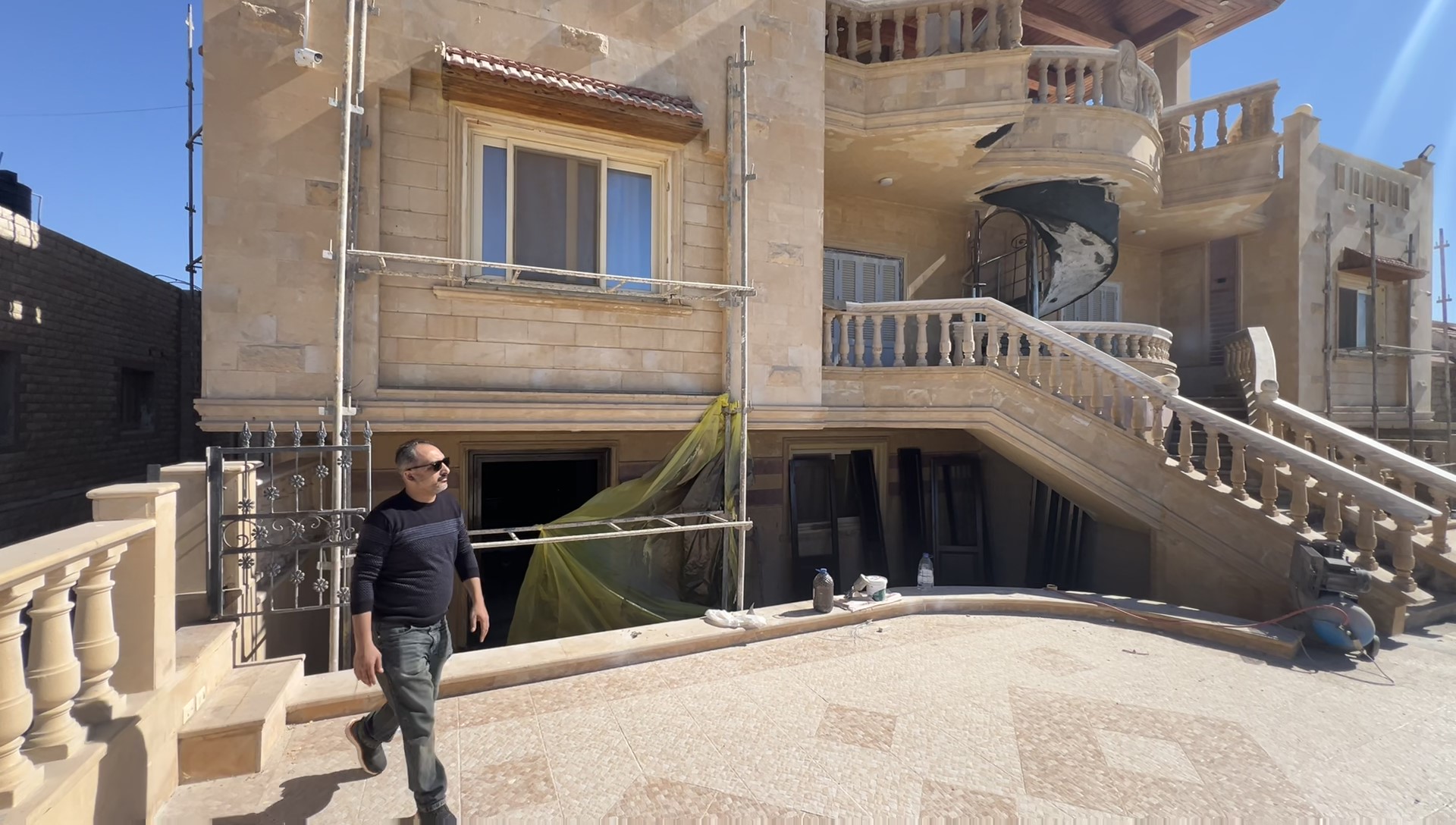
Moisture inspection on an interior wall to identify the water source before repairing the finish
How Do We Protect Waterproofing, Roofs, and Terraces After Handover?
We consider roofs and exposed surfaces areas that deserve particular attention because continuous exposure to weather makes early detection more valuable than waiting for a leak to appear inside the house.
During periodic inspections, we look for:
-
Changes in finishing layers.
-
Unusual water accumulation.
-
Damage or separation in specific details.
-
Problems around penetrations and service installations.
-
Joints and material interfaces.
-
Moisture traces in corresponding interior areas.
-
Drainage outlets and water-flow paths.
We do not associate waterproofing with one material or one universal solution.
The appropriate maintenance and repair approach depends on the project details, the installed system, and the site conditions.
This is where preserving construction information becomes especially valuable. Maintenance is more accurate when we know what was installed and where the critical layers and components are located.
What Should a Luxury Villa HVAC Maintenance Schedule Include?
HVAC is not a single appliance. It is a system that affects comfort, indoor air quality, energy consumption, and indoor humidity.
Therefore, we connect maintenance to the type of system, manufacturer instructions, operating pattern, and surrounding environment.
Our inspection focuses on:
-
Filter condition according to the system.
-
Cleanliness of components that require cleaning.
-
Unit performance.
-
Unexpected water or condensation.
-
Unusual sounds and vibration.
-
Comfort levels in occupied spaces.
-
Service areas and outdoor units.
-
Any noticeable difference between one space and another.
If one room begins to require longer operation to achieve the same comfort level it previously achieved, we do not consider this a minor observation. We treat it as a sign that deserves technical inspection.
Why Should Plumbing and Drainage Have Their Own Maintenance Log?
Plumbing systems can affect multiple architectural elements at the same time.
A small leak may reach a finish, ceiling, cabinet, waterproofing layer, or concealed area before it becomes visible to the user.
Therefore, we monitor:
-
Visible leaks.
-
Water pressure when unusual changes occur.
-
Drains.
-
Odors.
-
Slow drainage.
-
Pumps.
-
Water tanks.
-
Water heaters.
-
Access and maintenance points.
-
Any modifications to the network.
We connect this monitoring to the original design because the distribution of bathrooms, kitchens, and service rooms is not only an aesthetic decision. It also affects accessibility, maintenance, and coordination between systems.
In the design itself, we consider the relationship between wet spaces, ventilation, movement, odors, and airflow because early architectural decisions influence building performance years later.
Stages of Luxury Villa Design, Construction, and Handover
Luxury Villa Systems Inspection Table: What Do We Inspect and When Should We Escalate the Problem?
Smart maintenance does not treat the villa as a single element.
It divides it into interconnected systems. Each system has specific inspection points, an appropriate monitoring frequency, a clearly defined responsible party, and warning signs that indicate when routine monitoring should become technical or engineering intervention.
| System | What Do We Inspect? | Frequency | Who Inspects? | Escalation Warning Sign |
|---|---|---|---|---|
| HVAC | Performance, filters, condensation, abnormal operation | According to system and operating schedule | Technician | Continuous performance reduction or recurring problem |
| Plumbing | Leaks, water pressure, drainage, odors or unusual changes | Periodic | Owner / Technician | Recurring or unknown-source leak |
| Waterproofing | Moisture traces, water accumulation, joints, details, penetrations | Periodic and after significant conditions | Technician / Engineer | Recurring moisture or unclear source |
| Electrical | Panels, operation, lighting, switches, sensors, control systems | Periodic | Specialist | Recurring faults or abnormal electrical behavior |
| Façade | Joints, finishes, interfaces, visible changes or damage | Periodic | Technician / Engineer | Unusual or recurring deterioration |
| Pool | Pumps, filters, water quality, abnormal water loss, tiles, joints | Periodic | Technician | Water loss or continuous performance reduction |
| Landscape & Irrigation | Irrigation, drainage, leaks, water direction, plant growth and impact on the building | Periodic | Maintenance Team | Water reaching the building or façades |
How Do We Use This Table?
The purpose of the table is not to replace specialized technical inspection.
It creates a first line of early monitoring.
When a minor observation appears and does not recur, it can be recorded and monitored.
When the observation recurs, an unusual change appears, or the source of the problem is unclear, we move from routine maintenance to technical or engineering diagnosis.
This distinction is important in a luxury villa because a visible finish defect may originate entirely in another system.
Moisture may appear on a wall while the actual cause is plumbing or waterproofing. Façade deterioration may be related to a construction detail or drainage condition.
We therefore do not treat every sign as an isolated failure. We examine the relationship between systems before deciding how to repair it.
What Should We Inspect in Electrical Systems, Lighting, and Controls?
We do not consider lighting merely a finishing element.
In a luxury villa, interior and exterior lighting interact with façades, landscaping, movement, security, and sometimes automation and control systems.
During maintenance, we review:
-
Electrical panels.
-
Unusual operating behavior.
-
Interior and exterior lighting.
-
Control units.
-
Sensors, where applicable.
-
Architectural façade lighting.
-
Exterior lighting exposed to weather.
-
Wiring and components requiring specialist inspection.
Recurring faults should not be handled by repeatedly replacing the same component.
A recurring failure can be important diagnostic information.
How Do We Include the Swimming Pool, Landscape, and Irrigation in the Maintenance Schedule?
A luxury villa with a pool and landscaping is not only a building.
The exterior environment is part of the operating system. Water, movement, lighting, plants, and irrigation can affect both the user experience and certain building elements.
We therefore divide monitoring into several areas.
Swimming Pool
-
Water condition according to the operating system.
-
Filters, pumps, and equipment.
-
Unusual leakage or water loss.
-
Tiles and joints.
-
Pool edges and surrounding areas.
-
Lighting and associated equipment.
Irrigation
-
Performance of different zones.
-
Unintended spraying onto façades.
-
Leaks.
-
Blocked irrigation points.
-
Network pressure when an operating problem appears.
Landscape
-
Plant growth in areas that may affect the building.
-
Roots or growth near services.
-
Drainage condition.
-
Interaction between irrigation, façades, and pathways.
-
Exterior lighting.
This is an important architectural principle:
We do not design landscaping separately from the building, and after handover we do not treat it as a system unrelated to architecture.
Luxury villa swimming pool connected to terrace, landscape, and exterior lighting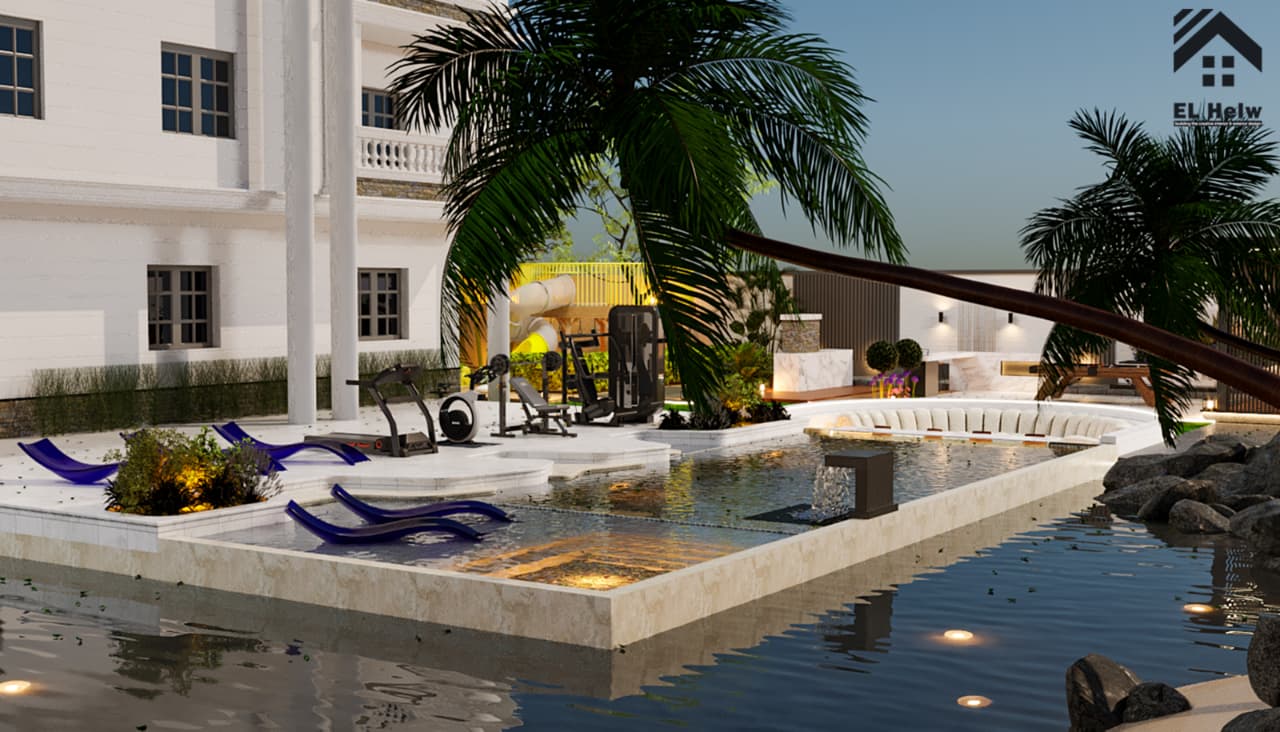
Swimming Pools in Luxury Villas and Palaces: Design and Costs
How Do We Connect Maintenance to Façades and Interior Finishes?
A façade is not a static image.
It is an envelope exposed to sunlight, wind, water, thermal changes, and environmental conditions.
Therefore, the maintenance approach varies according to the finishing system.
We inspect:
-
Stone or cladding condition.
-
Exterior paint.
-
Joints and interfaces.
-
Glass.
-
Aluminum Composite Material (ACM), where used.
-
Doors and windows.
-
Drainage details.
-
Water traces.
-
Interfaces between different materials.
Inside the villa, we do not monitor appearance alone.
Floors, walls, ceilings, joinery, and finishes can reveal problems in systems behind them.
If we see a gap, swelling, or discoloration, our first question is not:
“How do we restore the finish?”
It is:
“Is this change caused by movement, moisture, usage, or a problem in an underlying layer?”
Our material-selection approach considers service life, maintainability, environmental compatibility, and appearance. We consider this part of project quality rather than a decision separate from design.
What Should We Do at Handover to Make Future Maintenance Easier?
We believe the best maintenance schedule begins before the construction team leaves the site.
A good handover file should contain, depending on project scope:
-
Final drawings.
-
As-Built drawings where modifications have been made.
-
Equipment data.
-
Operation and maintenance manuals.
-
Available warranties and documentation.
-
Specifications of important materials.
-
Service-room locations.
-
Electrical drawings and panel information.
-
HVAC system data.
-
Pump and equipment information.
-
Control-system information.
-
Construction modification records.
This transforms the villa from a “building with unknown details” into a property with a technical record.
Our project approach already connects site study, design, construction drawings, quantity takeoff, execution, and handover, with client follow-up throughout the different stages.
How Do We Create an Actual Maintenance Log for the Villa?
The schedule alone is not enough.
We need a Maintenance Log that records what actually happened.
The log can include:
| Date | System | Observation | Action Taken | Result | Follow-up |
|---|---|---|---|---|---|
| Inspection date | HVAC | Performance change | System inspection | Cause identified | Follow-up review |
| Inspection date | Plumbing | Moisture | Source identification | Repaired | Reinspection |
| Inspection date | Façade | Finish change | Inspection | Cause identified | Monitoring |
We value these details because recurring problems become easier to understand when we examine their history rather than treating each occurrence as an isolated incident.
What Is the Difference Between Preventive and Corrective Maintenance?
Preventive maintenance begins with the principle:
We look for deterioration before failure.
Corrective maintenance begins after a problem appears.
| Element | Preventive Maintenance | Corrective Maintenance |
|---|---|---|
| Timing | Before failure | After failure appears |
| Objective | Prevent or reduce the likelihood of a problem | Repair the problem |
| Data | Based on periodic records | Based on the current failure |
| Planning | Can be organized | Often unexpected |
| Diagnosis | Looks for early indicators | Looks for the cause of the current problem |
This does not mean failures will disappear completely.
Every building requires maintenance and corrective work.
But a preventive system makes building management more informed and less dependent on unexpected failures.
Common Mistakes in Luxury Villa Maintenance After Handover
Luxury villa maintenance does not usually fail because there is no technician or because repairs are never performed.
It may fail because of the way maintenance itself is managed.
In many cases, every problem is treated as an isolated failure:
A leak is repaired.
An HVAC unit is cleaned.
Damaged paint is repainted.
A defective component is replaced.
But the actual problem may be deeper than the visible component.
Based on our experience in architectural design, construction, finishing, and engineering supervision, we find that many maintenance problems are connected to the absence of a system, failure to understand the relationship between different systems, or delaying intervention until the failure becomes obvious.
1. Waiting for Failure Before Starting Maintenance
One of the most common mistakes is treating maintenance as a repair process that begins after something fails.
When a leak appears, a plumber is called.
When HVAC performance decreases, a technician is called.
When paint starts peeling, the wall is repainted.
The problem is that the visible sign may be only the final stage of a process that began much earlier.
A moisture mark may appear after water has already moved through concealed layers or voids. HVAC performance may decline gradually before the system stops completely.
That is why Preventive Maintenance focuses on detecting changes before they become major failures.
The correct approach:
Record minor observations and compare them over time instead of waiting until they become failures.
2. Repairing the Symptom Instead of Finding the Cause
A visible ceiling or wall stain may be repaired without identifying the water source, only for the problem to return later.
Repainting may temporarily restore the appearance, but it does not solve the problem if the moisture source remains.
The same principle applies to many other systems.
For example, poor water drainage may appear as damage to an exterior finish while the actual cause is related to slope, drainage, or another detail.
The correct approach:
Before repairing, ask two questions:
-
What caused the problem?
-
Does the proposed repair address the cause or merely hide its effect?
If the problem returns after repair, this is an important indication that the previous diagnosis may not have been sufficient.
3. Treating Each System as Completely Separate
A villa is not a collection of systems that operate independently.
Plumbing interacts with finishes.
Waterproofing interacts with roofs and details.
Landscaping interacts with irrigation, drainage, and façades.
HVAC interacts with indoor comfort, condensation, and finishes.
Therefore, a problem may appear in one system while its cause exists in another.
A clear example is irrigation water repeatedly reaching a building façade. The visible issue may be treated as a façade problem even though the actual cause is related to irrigation.
The correct approach:
When a problem recurs, review the systems connected to it instead of limiting the diagnosis to the location where the defect appears.
4. Not Having a Maintenance Log
An important mistake is performing maintenance without recording what was inspected, changed, or repaired.
After several years, the owner may not remember:
-
When filters were cleaned or replaced.
-
When the problem first appeared.
-
Who performed the repair.
-
Which component was replaced.
-
Whether the failure recurred.
-
Whether the system was modified.
Without this information, future diagnosis becomes more difficult.
The correct approach:
Create a simple Maintenance Log containing the date, system, observation, action, responsible party, and result after repair.
5. Not Keeping As-Built and Handover Documentation
One of the mistakes whose importance becomes apparent years after handover is failing to preserve the project's technical information.
Final As-Built Drawings, equipment data, operation manuals, test records, and handover documentation can help explain how the system was actually installed.
This becomes particularly important when maintenance companies or teams change.
Without this information, every new technician may have to start from zero, and decisions may be based on assumptions rather than the actual installed system.
The correct approach:
Create a technical file for the villa containing available documentation related to the systems, completed works, maintenance, and later modifications.
6. Repeatedly Replacing the Same Component Without Diagnosis
If one component fails several times, replacing it every time is not necessarily a solution.
Repeated failure can be diagnostic information indicating that an underlying cause has not been addressed.
The cause may involve operating conditions, another part of the system, installation methods, or an interaction between multiple components.
The correct approach:
When the same failure recurs, move from asking:
“Which component failed?”
to asking:
“Why does this component keep failing?”
This shift is one of the most important differences between reactive maintenance and smart maintenance.
7. Ignoring Non-Visible Areas
Visible areas often receive more attention because they directly affect the villa's appearance.
However, important systems may be located in areas users do not see every day, including service rooms, electrical panels, pumps, operating equipment, drainage points, and certain roof or technical spaces.
Ignoring these areas because they do not directly affect appearance may allow problems to develop unnoticed.
The correct approach:
The maintenance schedule should cover both visible and concealed systems, not only visible finishes.
8. Ignoring Small Signs of Moisture
A minor paint discoloration, unusual odor, or limited swelling may appear to be a cosmetic issue.
In some cases, however, it may be an early sign of a water or moisture problem.
This does not mean every paint change indicates waterproofing failure or leakage. It means that a recurring or unexplained change deserves investigation.
The correct approach:
Record the location and date of the sign, monitor whether it recurs, and request technical assessment if it persists, expands, or is accompanied by a clear moisture source.
9. Neglecting Waterproofing Because It Is Not Visible During Daily Use
Waterproofing is one of the systems whose importance users may not notice while everything works normally.
But a problem that appears much later can make identifying and repairing the source more complicated.
Therefore, roof and water-exposed areas should not be monitored only after a leak appears inside the building.
We should also observe:
-
Unusual water accumulation.
-
Changes in finishes.
-
Damaged joints.
-
Penetrations and service points.
-
Drain condition.
-
Interior moisture signs associated with exterior areas.
The correct approach:
Periodic inspection is better than waiting for water to enter interior spaces.
10. Allowing Irrigation and Landscaping to Affect the Building Without Monitoring
Landscaping does not become unrelated to the building after handover.
Plant growth, changes in irrigation paths, irrigation leaks, or repeated water exposure to façades and pathways can affect the performance of areas surrounding the building.
The roots of certain plants may also require monitoring in relation to services, paths, and constructed areas.
The correct approach:
Review the relationship between irrigation, landscaping, façades, and drainage rather than monitoring plant health alone.
11. Making Modifications Without Reviewing Their Impact on Existing Systems
A major maintenance mistake is making post-handover modifications without studying their impact on existing systems.
Adding equipment, changing routes, modifying finishes, installing new units or systems, or carrying out roof work may affect other elements.
The problem is not the modification itself.
The problem is making the modification without understanding its relationship with the existing system.
The correct approach:
Any significant modification should be preceded by an assessment of what may be affected, including electrical systems, plumbing, waterproofing, HVAC, finishes, or structural elements, depending on the nature of the modification.
12. Treating Maintenance Cost as an Expense That Can Always Be Postponed
Postponing periodic inspection may appear to reduce short-term spending.
However, postponement can allow a problem to become larger and require more extensive intervention later.
There is a difference between planned maintenance cost and the cost of repairing a failure that has developed and affected more than one system.
Therefore, maintenance should not be viewed only as an operating expense. It is also part of preserving the property's performance, finishes, systems, and long-term value.
13. Not Assigning Clear Responsibility for Each System
When it is unclear who is responsible for monitoring each system, a problem may move between different parties without anyone taking full responsibility for diagnosing it.
For example, an owner may report a problem to the finishing team. The finishing team may believe it is related to plumbing, while the plumbing technician may consider the source unclear.
The correct approach:
Assign a clear person or party for the initial monitoring of each system, with a defined escalation point when the problem exceeds routine maintenance.
14. Confusing Routine Maintenance with Engineering Intervention
Not every problem requires an engineer, but not every problem can be solved by a maintenance technician.
Simple cleaning or routine operational procedures may fall under normal maintenance.
A recurring, unknown-source problem, or one involving multiple systems, may require technical or engineering assessment.
Warning signs that require escalation include:
-
The problem returns after repair.
-
The source is unclear.
-
More than one system is affected.
-
Moisture repeatedly appears.
-
Damage is increasing.
-
A design or construction modification is required.
-
There may be an impact on structural elements or major systems.
The maintenance schedule should therefore clearly define when routine inspection ends and specialist diagnosis begins.
How Do We Use Engineering Judgment Instead of a Blind Maintenance Checklist?
We prefer every observation in the maintenance log to include a diagnostic question.
For example:
A moisture stain appears on the ceiling.
We do not simply record:
“Paint repaired.”
Instead, we record the decision path:
Water source unidentified → inspect area above → review services or waterproofing according to location → identify source → repair → reinspect → restore finish after confirming that the cause has been addressed.
This approach is more valuable because it preserves the logic behind the decision, not only the final result.
This is also part of our philosophy when dealing with construction challenges: a challenge should not be viewed only as an obstacle, but as an opportunity to improve the project when it is properly diagnosed.
How Do We Connect Maintenance to Sustainability and Long-Term Villa Value?
We do not separate sustainable design from maintenance.
When we study solar orientation, wind, building orientation, glazing ratios, glass, insulation, shading devices, and materials, we think about building performance throughout its operating life, not only its appearance on handover day.
However, sustainability does not mean that every building requires the same technology.
The appropriate decision depends on the location, climate, use, materials, and engineering systems.
After handover, maintenance helps preserve the performance the building was designed to achieve.
A system that is not monitored may lose part of its operating efficiency, while periodic inspection helps identify changes early.
This is consistent with our philosophy of considering sustainability part of design from the earliest stages rather than as a decorative addition later.
Field Experience: What Have We Learned from Maintaining Palaces and Complex Projects?
Maintenance in luxury villas and palaces does not depend only on following a fixed periodic schedule. Some problems do not appear as direct failures. They begin as small signs that gradually develop if their underlying cause is not properly analyzed.
Through practical experience with high-value buildings, we have found that the most valuable maintenance decisions begin with understanding the relationship between different systems, rather than simply repairing the part where the problem appeared.
Problem → Engineering Decision → Why? → Result
1. When the Problem Is Larger Than the Visible Symptom
In some cases, the problem may appear as a simple finish change, localized moisture, peeling paint, façade discoloration, or unexplained reduction in system performance.
The common mistake is to treat the visible part as the source of the problem.
In large and complex buildings, however, the visible symptom may simply be the result of another concealed problem.
The engineering decision is therefore not to repair only the damaged area, but to trace the possible sequence of causes:
Visible symptom → related system → source of failure → reason for recurrence → appropriate solution.
The objective is not only to restore the finish but to prevent the problem from returning.
2. Sheikh Ali Palace: Understanding the Problem as Part of the Building System
In major projects such as Sheikh Ali Palace, the importance of treating the building as a group of interconnected systems becomes clear.
When a problem appears in one element, the engineering question is not simply:
How do we repair this part?
The more important question is:
What caused the problem, and are there other systems connected to it?
This approach is especially important in buildings with large areas, multiple mechanical and electrical systems, high-value finishes, and extensive interior and exterior elements that need to maintain both performance and appearance.
This is why maintenance documentation matters. Recording the location of a problem, when it appeared, and what action was taken helps determine whether it was an isolated event or part of a recurring pattern.
3. El Saba Palace: Maintenance as Continuous Monitoring, Not Just Repair
In projects such as El Saba Palace, the importance of continuously monitoring elements and systems that may be affected by time, usage, or surrounding conditions becomes clear.
The objective of preventive maintenance is not to wait for failure. It is to identify early signs of deterioration and address them before they become larger and more expensive problems.
Maintenance records therefore become operationally valuable because they allow us to compare system condition over time rather than evaluating it at one isolated moment.
If the same observation keeps recurring, or if one system repeatedly requires intervention, this may indicate the need to reassess the underlying cause instead of continuing with partial repairs.
What Have We Learned from These Experiences?
The most important practical lessons we connect with long-term maintenance of luxury villas and palaces include:
-
The visible failure is not always the source of the problem.
The root cause should be investigated before simply repairing the effect. -
Recurrence matters more than a single occurrence.
A recurring problem deserves a deeper review of the system, operating conditions, or previous construction. -
Documentation is part of maintenance, not merely administration.
Recording inspections, repairs, dates, and observations creates a real history of building performance. -
Systems are interconnected.
Moisture may be related to waterproofing, drainage, or ventilation, and a problem in one system may affect finishes or other systems. -
Preventive intervention is often preferable to waiting for complete failure.
Detecting deterioration early provides more options before the problem expands. -
The building changes over time.
The maintenance program should therefore evolve according to actual data and observations rather than remaining a fixed schedule.
How Do We Use This Experience in the Maintenance Schedule?
Based on this approach, we do not consider the maintenance schedule merely a list of separate tasks. We consider it a decision-making tool.
When we record:
-
Inspection date.
-
System or element inspected.
-
Observation.
-
Problem severity.
-
Action taken.
-
Person or company responsible for the repair.
-
Follow-up result.
We can move from traditional maintenance toward building performance management.
This distinction is important in a luxury villa because maintenance value is not measured only by the number of failures repaired. It is also measured by the ability to preserve performance, comfort, safety, appearance, service life, and property value over the long term.
The Most Important Lesson
Field experience in large projects confirms that effective maintenance is not about intervening more often.
It is about detecting the problem at the right time, identifying its actual cause, selecting the appropriate level of intervention, documenting the result, and following up.
For this reason, we recommend that every luxury villa have a clear system beginning with handover documentation, followed by periodic inspection, observation recording, recurring-problem analysis, and engineering review whenever the issue exceeds the scope of routine maintenance.
What Have Complex Projects Taught Us About Maintenance and Documentation?
In large or complex projects, it becomes clear that building quality does not depend on a single decision.
We work across different types of projects, from villas and palaces to other specialized developments, and this variety reinforces our approach of viewing the building as an integrated system rather than as a façade alone.
In Sheikh Ali Palace, for example, the project approach began with studying the site, views, wind, sunlight, and privacy before shaping three interconnected villas within one overall composition.
This type of decision demonstrates why building performance cannot be separated from site conditions and design decisions.
In El Saba Palace, part of the construction was carried out independently and technical and architectural issues subsequently appeared. The work required reviewing the completed work, redesigning certain elements, and addressing the execution path.
The example is not directly about post-handover maintenance, but it illustrates an important principle:
When a problem appears, the value of engineering work lies in understanding the cause and recalibrating the system rather than hiding the effect of the problem.
This is how we want clients to understand the concept of “follow-up.”
It is not simply a visit. It is understanding the history of decisions, construction, and modifications.
How Do We Customize the Maintenance Schedule According to Villa Type?
There is no single villa model that applies to every project.
Coastal Villa
We place greater emphasis on exposure of façades and exterior elements to environmental conditions, as well as outdoor systems, lighting, landscaping, and water systems according to the project.
Villa Within a Gated Community
The priority may include coordination between the villa's systems and the site's service infrastructure, in addition to the home's internal and external systems.
Villa with a Large Pool and Extensive Landscaping
We add a complete operational layer for water systems, irrigation, pumps, lighting, and exterior spaces.
Villa with Smart Control Systems
We need to document system components, control points, software or operational modifications, and related network components according to the design.
This is why we always emphasize that the architectural solution changes according to location, environment, and use.
There is no fixed template for every project.
How Can Smart Maintenance Help Us Reassess the Villa in the Future?
Maintenance does more than preserve the building.
It produces information about the building.
After a period of operation, we may discover:
-
An area where a particular problem repeatedly occurs.
-
A system that requires more monitoring than others.
-
A finish that is not appropriate for actual usage conditions.
-
Modifications that have affected access to services.
-
Equipment that should be replaced through planned intervention rather than after failure.
-
An exterior area that requires irrigation or drainage reorganization.
At this point, maintenance records become a tool for future decision-making.
If the owner decides to redesign or upgrade part of the villa, the maintenance history helps the engineer understand the area's history instead of starting from zero.
What Is Our Smart Post-Handover Villa Inspection Checklist?
Building and Architecture
-
Inspect façades.
-
Inspect roofs and terraces.
-
Monitor joints and interfaces.
-
Review doors and windows.
-
Monitor unusual changes in finishes.
Water and Waterproofing
-
Look for moisture traces.
-
Monitor leaks.
-
Inspect wet areas.
-
Monitor drainage.
-
Review penetrations and critical details.
Electrical
-
Monitor recurring faults.
-
Have electrical panels reviewed by a specialist.
-
Inspect lighting.
-
Monitor exterior lighting.
-
Review control systems.
HVAC
-
Monitor performance.
-
Check filters according to the system.
-
Monitor condensation.
-
Monitor unusual sounds and vibration.
-
Inspect units and service areas.
Plumbing
-
Check for leaks.
-
Monitor drainage.
-
Inspect pumps.
-
Inspect tanks.
-
Inspect water heaters.
-
Record any network modifications.
Swimming Pool
-
Inspect equipment.
-
Inspect pumps.
-
Inspect filters.
-
Monitor water according to the operating system.
-
Inspect finishes and pool edges.
-
Inspect lighting.
Landscaping
-
Monitor irrigation.
-
Monitor drainage.
-
Monitor plant growth.
-
Monitor the effect of water on the building.
-
Inspect exterior lighting.
Documentation
-
Update As-Built information.
-
Update equipment data.
-
Preserve warranties.
-
Maintain the maintenance log.
-
Maintain the modification record.
How Do We Build a Maintenance System That Does Not Consume the Owner’s Time?
The purpose of a smart maintenance schedule is not to turn the villa owner into a full-time maintenance manager.
We prefer a three-layer model.
Layer One: Monitoring
Simple observations that the owner or household team can record.
Layer Two: Technical Maintenance
Periodic procedures performed by qualified technicians according to system type and manufacturer requirements.
Layer Three: Engineering Review
Intervention when there is an unclear problem, recurring issue, architectural or structural modification, or conflict between systems.
This structure allows each party to understand what they monitor, what they do, and when specialist assistance is required.
How Do We Know When a Villa Needs a Comprehensive Engineering Review?
We consider a comprehensive engineering review useful when several indicators appear, such as:
-
Frequent failures across more than one system.
-
Numerous undocumented modifications.
-
Recurring moisture problems.
-
Difficulty accessing service rooms.
-
Missing As-Built drawings.
-
Differences between actual construction and available drawings.
-
Problems whose root causes remain unresolved.
-
Equipment purchases or system changes made without updating documentation.
In such cases, the solution is not simply to add more tasks to the maintenance schedule.
The relationship between the building and its systems should be reviewed.
How Do We Include “Maintenance Value” in Design Decisions from the Beginning?
We do not wait until handover to think about maintenance.
When selecting a material or detail, we consider:
-
Service life.
-
Accessibility.
-
Ease of cleaning.
-
Environmental suitability.
-
Replaceability.
-
Compatibility with other systems.
-
Impact on operation.
-
Future maintenance cost within the overall project picture.
This does not mean choosing the cheapest material, nor does it mean choosing the most expensive one.
We look for the best value relative to cost.
This is a principle we apply when evaluating materials and suppliers.
How to Prevent Construction Budget Overruns and Project Delays
Maintenance Tips from Elhelw for Preserving a Luxury Villa After Handover
We summarize our smart maintenance philosophy in several practical decisions:
-
Do not wait for a system to stop if an abnormal sign appears.
-
Do not treat moisture with paint before identifying its source.
-
Keep a complete technical file for the villa.
-
Update drawings whenever modifications are made.
-
Connect each piece of equipment with its technical data and operating instructions.
-
Do not use one maintenance schedule for every system.
-
Record recurring failures instead of forgetting them after repair.
-
Monitor service rooms with the same attention given to visible spaces.
-
Make maintenance part of the design decision rather than a separate stage.
-
When the problem is unclear, diagnose it before repairing it.
We believe project success is not measured only by how beautiful the villa looks in photographs on handover day.
It is also measured by its ability to serve its users and preserve its value over time.
This is a fundamental part of our office philosophy.
Decision Framework: When Should We Inspect, Repair, or Call an Engineer?
The decision can be summarized as follows:
Simple observation
→ Record it
→ Monitor it
Clear operational problem
→ Technical maintenance according to the system
Recurring problem
→ Diagnose the cause
Unknown-source problem
→ Specialist inspection
Unknown moisture or leak
→ Identify the water source before restoring the finish
Modification to an existing building
→ Engineering review before execution
Problem that may affect safety or a structural element
→ Immediate specialist engineering intervention
This is not simply an emergency checklist.
It is a way of thinking that prevents us from making a repair decision before understanding the nature of the problem.
Frequently Asked Questions
Q: When should villa maintenance begin after handover?
A: We begin from the handover stage itself by documenting systems, equipment, drawings, and modifications. We then establish a periodic program appropriate to the villa's characteristics, systems, and manufacturer requirements.
Q: Is there one maintenance schedule that works for every luxury villa?
A: No. We use a general preventive-maintenance framework and then customize the timing and tasks according to HVAC, electrical, plumbing, waterproofing, pool, landscaping, irrigation, and actual villa usage.
Q: Does moisture mean that the paint needs to be replaced?
A: Not necessarily. We identify the moisture source first. It may be related to plumbing, drainage, waterproofing, the façade, or condensation. Repainting before addressing the source may cause the problem to return.
Q: When do I need an engineer instead of a maintenance technician?
A: Engineering review is appropriate when the source is unclear, the problem recurs, or the issue involves waterproofing, the building itself, modifications, or multiple systems simultaneously.
Q: Is maintenance part of design, or does it begin after construction?
A: We consider maintainability part of design quality. Material selection, service distribution, equipment accessibility, and documentation of modifications all affect future maintenance.
Conclusion: A Luxury Villa Needs an Operating System, Not Just a List of Failures
A smart maintenance schedule for a luxury villa after handover is not simply a file containing dates.
We see it as a system that begins with handover documentation, followed by an Asset Register, inspection schedule, Maintenance Log, and Decision Framework that determines when routine inspection is sufficient and when technical or engineering intervention is required.
Most importantly, maintenance should read the building according to how it was designed and constructed.
When we understand the relationship between façades and waterproofing, plumbing and finishes, HVAC and indoor comfort, irrigation and landscaping, and service rooms and maintenance access, our decisions become more accurate.
A successful villa is not simply one that looks luxurious on handover day; it is one that continues to operate, serve its users, and preserve its value over the years.
Luxury Villa Design, Construction, and Engineering Supervision
> Smart maintenance does not wait for failure; we look for the sign that comes before it.